
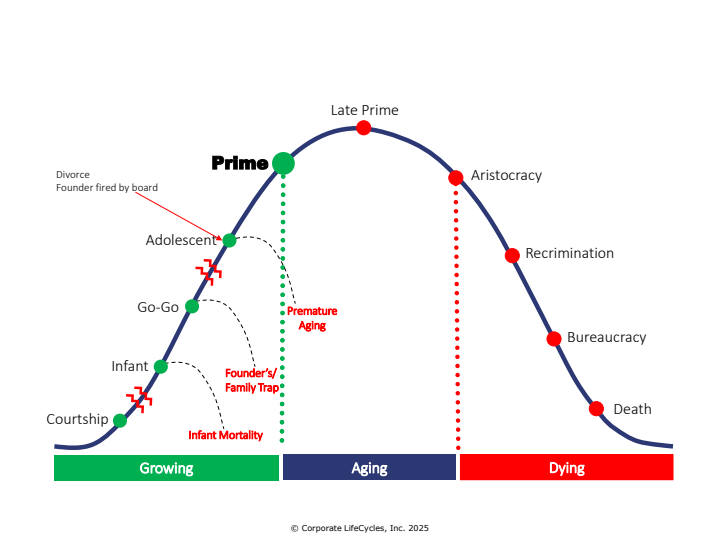
Organizations progress through a series of predictable stages as they grow and age. Each of these stages brings repetitive patterns of behavior, predictable problems, and in some cases unique challenges. How well or how poorly leadership develops the capabilities to overcome those problems and challenges will determine the long-term success or failure of the enterprise.
Leading organizations through these transitions is neither easy nor obvious. The requirements for success at any given stage can lead to failure at a different stage. Knowing what to do and what not to do is therefore need-to-know information for every CEO, C-Level Executive, Board Member, and Investor, as well as leaders who aspire to hold those positions in the future.
When an entire management team understands the lifecycle model, they share six insights that are critical to the long-term success of their enterprise:
- PRIME is the only stage where a company can dominate its markets, sustain a position of leadership, and enjoy above average growth in sales and profitability. The first challenge is to become Prime; the second challenge is to stay there. Unless leadership takes proactive steps to stay in PRIME, aging will automatically occur.
- Problems are desirable. Many managers have a negative reaction to the idea that their organization has ‘problems.’ The lifecycle model teaches us that the opposite is true. The only stage where an organization has no problems is Death.
- Many problems are not unique. This model also teaches us that most of the issues a company faces are not unique to the organization. There are predictable and repetitive patterns of behavior for each lifecycle stage.
- Some problems are normal, and others are abnormal. Normal problems require little attention because the organization will grow out of them. Leaders must focus on resolving abnormal issues because these will inhibit healthy development and progress.
- The demands of leadership are different for each stage. Successfully leading a Go-Go organization requires a vastly different approach than one in Adolescence. Management style, goals, strategies, structures, metrics, and rewards will differ markedly from one stage to the next. Leaders who understand what is required can accelerate their journey to Prime.
- Aging can be prevented, and it can also be reversed. Unlike humans, organizations can stop the aging process and remain perpetually youthful. The factors that cause aging can be diagnosed, and steps can be taken to prevent or reverse aging.